
An 18-Year-Old Burn Patient Received a World-First Exosome Treatment
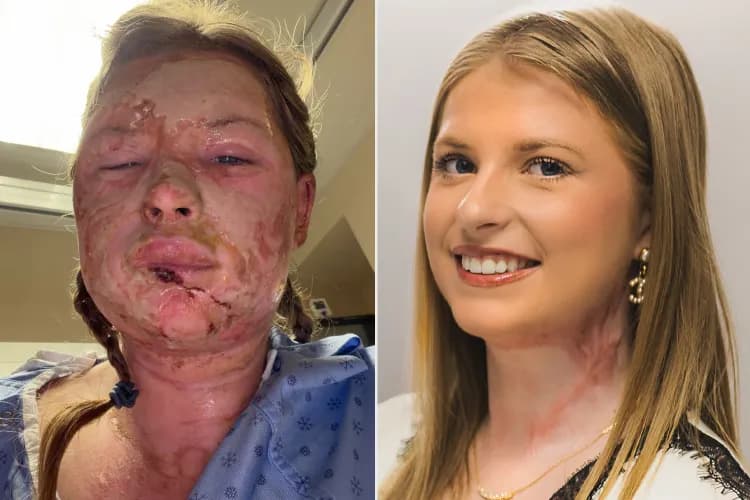
Kaitlin Jeffrey reportedly avoided facial and neck skin grafting after experimental exosome injections, but this remains a single case, not established burn care.
Topics
- Published
- Jun 24, 2026, 9:14 AM EDT
- Updated
- Jun 25, 2026, 10:02 AM EDT
- Reviewed
- Jun 25, 2026
- Status
- Developing
- Original source
- Hamilton Health Sciences
- VV source card
- Source graph record
- Verification
- Corroborated reporting
- Confidence
- medium high
- Urgency
- medium
Rapid orientation
The 5-second read
- What happened
- This is a striking single-patient experimental case where exosome injections were used after severe burns and facial/neck grafting was avoided. It does not prove the treatment caused the outcome or works generally.
- Why it matters
- If repeatable, reducing facial and neck grafting after severe burns could preserve identity, function, and quality of life.
- Status
- Developing
- Overclaim risk
- High
- Primary source
- Hamilton Health Sciences (Official)
- Next thing to watch
- More treated patients, peer-reviewed clinical data, adverse-event reporting, dosing details, and a formal protocol.
Signal context
Known so far
- Patient
- Kaitlin Jeffrey, 18
- Location
- Ontario, Canada
- Treatment site
- Hamilton General Hospital / Hamilton Health Sciences
- Intervention
- Two experimental exosome injection treatments
- Reported outcome
- Facial and neck skin grafting reportedly avoided
- Evidence level
- Single experimental patient case
- Regulatory status
- Experimental, not established burn care
VV Brief Matrix v1.0
VV Brief Signal Score
A derived editorial signal score for how timely, source-backed, important, and bounded this brief is. It helps explain why we covered the story now. It is not a medical evidence score or treatment recommendation.
67/100
Watch Brief
- Source proximity
- 92/100, weight 18%
- Verification strength
- 82/100, weight 20%
- News cycle urgency
- 58/100, weight 14%
- Human/share signal
- 95/100, weight 12%
- Clinical/scientific importance
- 90/100, weight 16%
- Follow-up value
- 88/100, weight 12%
- Confidence
- 74/100, weight 8%
This brief scores high because human/share signal, source proximity, clinical/scientific importance, but an overclaim penalty of 16 keeps the framing bounded.
Claim Check
DevelopingAn 18-year-old burn patient became the first reported burn patient to receive experimental exosome injections and recovered without facial or neck grafting.
Safe framing
This is a striking single-patient experimental case where exosome injections were used after severe burns and facial/neck grafting was avoided. It does not prove the treatment caused the outcome or works generally.
What happened
Kaitlin Jeffrey, 18, suffered severe facial and neck burns after a December 2025 fraternity-house fire. At Hamilton General Hospital, she received two experimental exosome injection treatments.
The reported result is emotionally powerful: facial and neck grafting was avoided. People also reported a one-trillion-exosome detail, which adds social gravity but should not be treated as proof of efficacy.
The boundary is the point. One experimental patient case cannot establish causality, safety, ideal dosing, manufacturing quality, or whether the same outcome would happen in other burn patients.
Vital Signals
Get the weekly health signal without the wellness fog.
A clean weekly brief covering longevity science, fitness, nutrition, medicine, health culture, and the claims worth questioning.
No spam. No selling your information. Unsubscribe anytime.
By subscribing, you agree to receive email from Viral Vitalism. Unsubscribe anytime. See our Privacy Policy.
Why it matters
- If repeatable, reducing facial and neck grafting after severe burns could preserve identity, function, and quality of life.
- The story sits at the edge of regenerative medicine, trauma care, and public hype.
- It is exactly the kind of signal that needs hope and brakes at the same time.
What not to overclaim
- Do not say exosomes heal burns.
- Do not say this proves regenerative medicine can prevent skin grafting.
- Do not generalize from one patient.
- Do not ignore safety, dosing, manufacturing, and protocol uncertainty.
- Do not imply causality from one case.
Signal context
Context
- Primary topic
- Regenerative Medicine
- Source date
- Jun 15, 2026
- Source stack
- 2 sources
- Current status
- Developing
VV caution: Exosomes are extracellular vesicles involved in cell signaling. Their proposed regenerative role in burns remains early, and this case should be framed as experimental compassionate-style care unless a formal trial pathway is documented.
Evidence trail
Source stack
- PrimaryOfficialJun 15, 2026Hamilton Health Sciences: World-first burn exosome treatment
- IndependentTrade newsJun 18, 2026People: Student, 18, recovers after experimental burn treatment
Research map
View associated studies
Research records connected to this brief through canonical sources, topic tags, or timeline events.
No directly linked studies are available for this page yet. Topic-only matches are not shown as evidence.
Related briefs
More brief coverage
Human Breakthrough Desk
Help us find and amplify more stories like this.
Some health stories should not vanish after one news cycle. Support the independent desk finding patient wins, medical breakthroughs, and human stories worth moving.
Support the Human Breakthrough Desk