
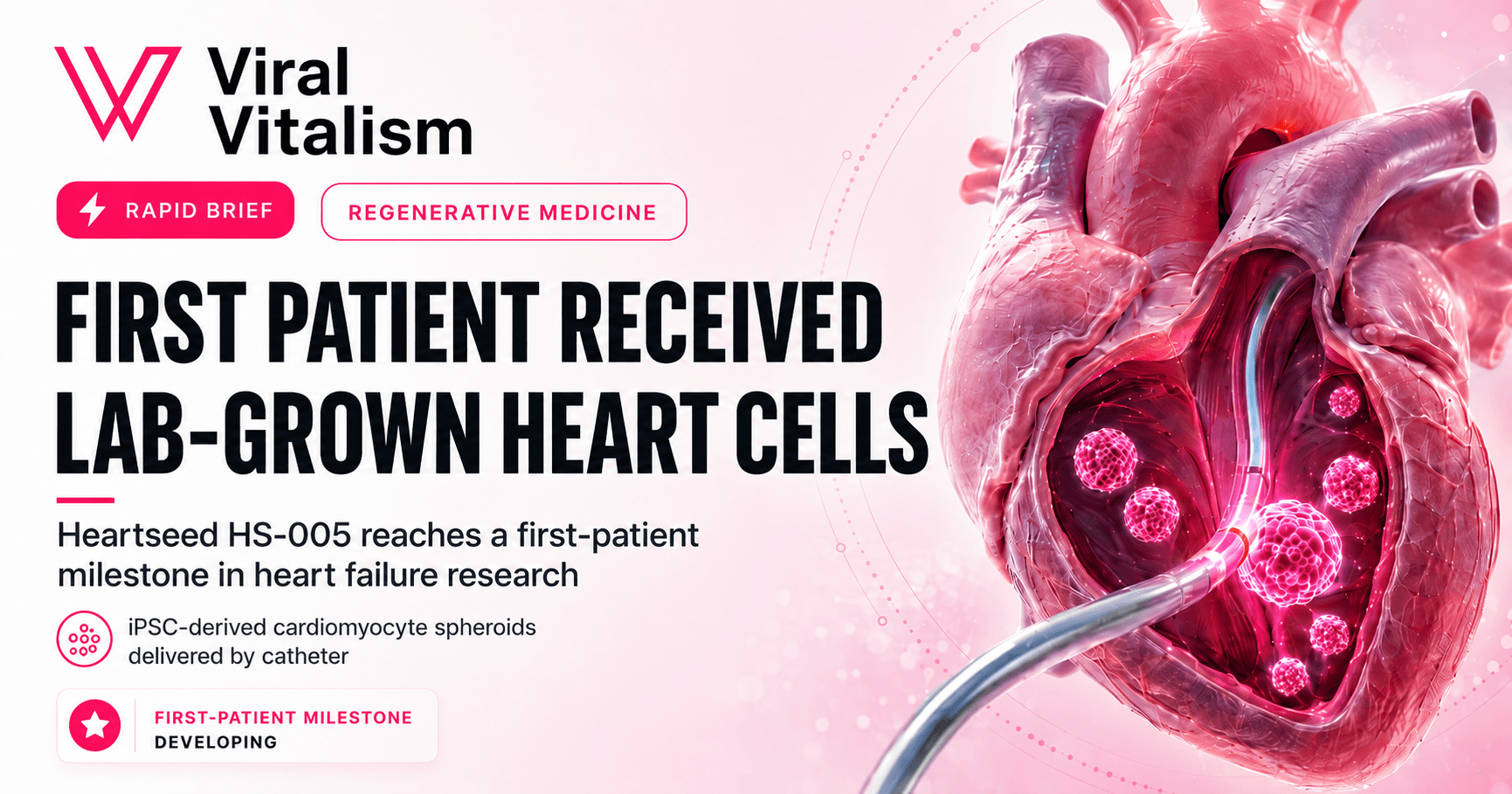
A First Patient Received Catheter-Delivered Lab-Grown Heart Cells
Heartseed's HS-005 program reportedly treated its first dilated cardiomyopathy patient with iPSC-derived cardiomyocyte spheroids delivered by catheter.
Topics
- Published
- Jun 28, 2026, 9:14 AM EDT
- Updated
- Jul 8, 2026, 10:02 AM EDT
- Reviewed
- Jul 8, 2026
- Status
- Developing
- Original source
- Regen Report
- VV source card
- Source graph record
- Verification
- Corroborated reporting
- Confidence
- medium high
- Urgency
- high
Rapid orientation
The 5-second read
- What happened
- This is a first-patient Phase I/II milestone. It is not evidence that the therapy improves heart function, survival, symptoms, or transplant avoidance.
- Why it matters
- This affects how patients, clinicians, regulators, or families may talk about Regenerative Cardiology right now.
- Status
- Developing
- Overclaim risk
- High
- Primary source
- Regen Report (Official)
- Next thing to watch
- Registry details, enrollment count, adverse events, LVEF and functional endpoints, durability, additional patient dosing, and whether catheter delivery avoids open-heart surgery burdens.
Signal context
Known so far
- Program
- HS-005 / EMERALD
- Disease
- Dilated cardiomyopathy
- Approach
- iPSC-derived cardiomyocyte spheroids
- Status
- First-patient milestone requiring primary verification
- Primary topic
- Regenerative Cardiology
- Source basis
- 4 canonical source records
- Review status
- Published after source-library review
VV Brief Matrix v1.0
VV Brief Signal Score
A derived editorial signal score for how timely, source-backed, important, and bounded this brief is. It helps explain why we covered the story now. It is not a medical evidence score or treatment recommendation.
71/100
Strong Brief
- Source proximity
- 92/100, weight 18%
- Verification strength
- 82/100, weight 20%
- News cycle urgency
- 88/100, weight 14%
- Human/share signal
- 95/100, weight 12%
- Clinical/scientific importance
- 90/100, weight 16%
- Follow-up value
- 80/100, weight 12%
- Confidence
- 74/100, weight 8%
This brief scores high because human/share signal, source proximity, clinical/scientific importance, but an overclaim penalty of 16 keeps the framing bounded.
Claim Check
DevelopingRegen medicine trade coverage reported first-patient treatment in Heartseed's EMERALD trial of HS-005 for dilated cardiomyopathy.
Safe framing
This is a first-patient Phase I/II milestone. It is not evidence that the therapy improves heart function, survival, symptoms, or transplant avoidance.
What happened
Regen medicine trade coverage reported first-patient treatment in Heartseed's EMERALD trial of HS-005 for dilated cardiomyopathy.
This is a first-patient Phase I/II milestone. It is not evidence that the therapy improves heart function, survival, symptoms, or transplant avoidance.
The public version is anchored to canonical source records and should be read through the lens of Regenerative Cardiology rather than social amplification alone.
The claim stays limited to the named source stack, reported population, product, institution, and follow-up window.
Vital Signals
Get the weekly health signal without the wellness fog.
A clean weekly brief covering longevity science, fitness, nutrition, medicine, health culture, and the claims worth questioning.
No spam. No selling your information. Unsubscribe anytime.
By subscribing, you agree to receive email from Viral Vitalism. Unsubscribe anytime. See our Privacy Policy.
Why it matters
- This affects how patients, clinicians, regulators, or families may talk about Regenerative Cardiology right now.
- Canonical source pages make the evidence path easier to inspect before readers open original URLs.
- The brief is useful only when the reported outcome stays separate from broad proof, access, or standard-care claims.
What not to overclaim
- Do not treat this as proof beyond the named source, population, product, institution, and follow-up window.
- Do not imply broad access, routine use, or superiority without comparative evidence.
- Do not turn patient, company, regulatory, or institutional reporting into a universal outcome claim.
Signal context
Context
- Primary topic
- Regenerative Cardiology
- Source date
- Jun 27, 2026
- Source stack
- 4 sources
- Current status
- Developing
VV caution: Reviewed for public wording, canonical source links, and claim boundaries.
Evidence trail
Source stack
- PrimaryOfficialHeartseed/Nikon: first patient dosed in Phase I/II EMERALD study of HS-005
- Additional contextOfficialClinicalTrials.gov: HS endocardial delivery study record
- Additional contextTrade newsHeartseed PDF: first clinical trial of catheter administration of iPSC-derived cardiomyocyte spheroids
- IndependentTrade newsJun 27, 2026Regen Report: Heartseed HS-005 first-patient report
Research map
View associated studies
Research records connected to this brief through canonical sources, topic tags, or timeline events.
No directly linked studies are available for this page yet. Topic-only matches are not shown as evidence.
Related briefs
More brief coverage
Human Breakthrough Desk
Help us find and amplify more stories like this.
Some health stories should not vanish after one news cycle. Support the independent desk finding patient wins, medical breakthroughs, and human stories worth moving.
Support the Human Breakthrough Desk